Cohorts that respect consent.
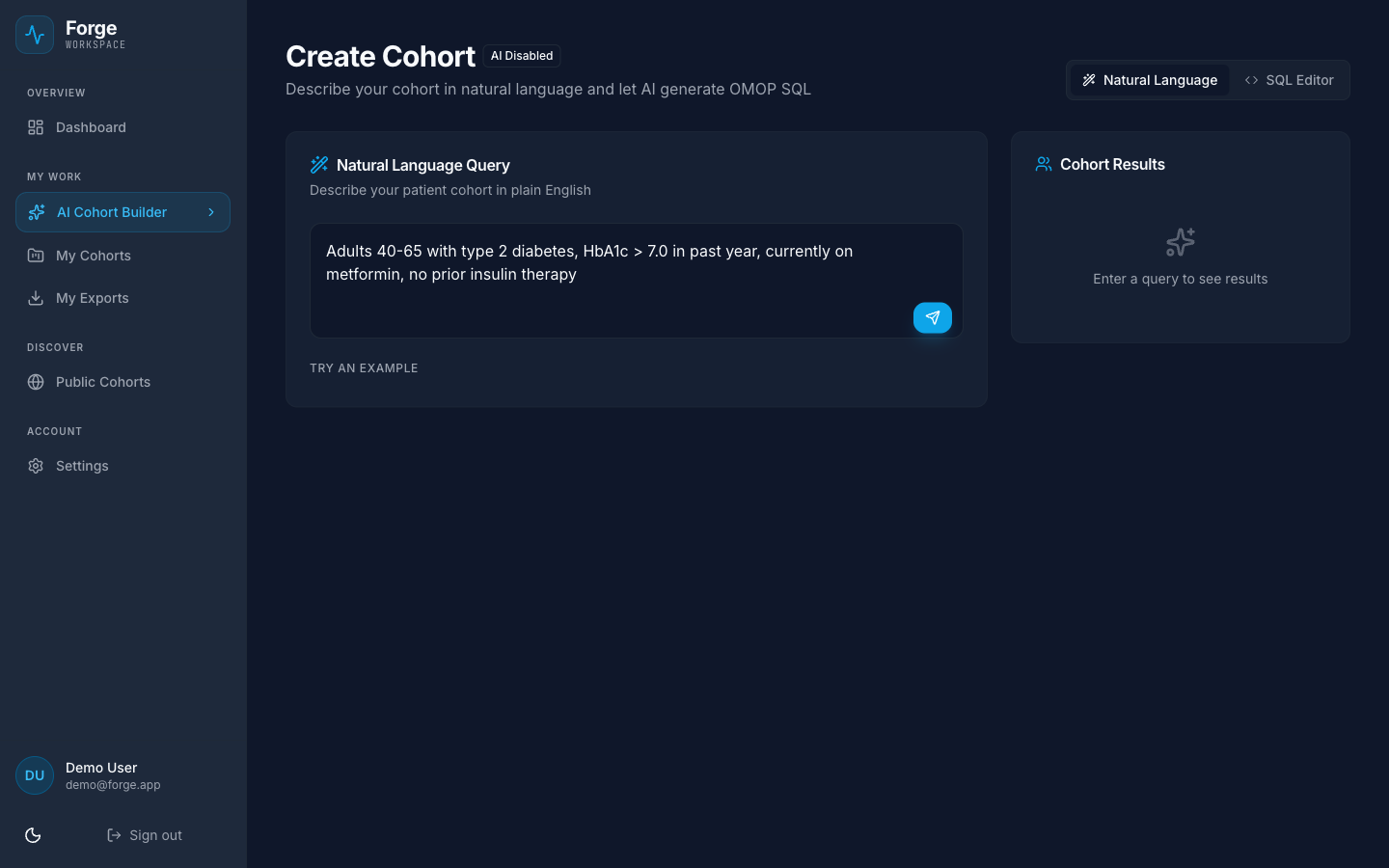
Cohort tools like OHDSI Atlas or i2b2 select patients by clinical criteria; consent is handled upstream, outside the tool. Forge is built so that every query runs inside consent scope and every access is HAVEN-audited. The reference implementation does this today for study enrollment and payout; consent-scoped cohort export is the next milestone. Developed and tested on a MIMIC-IV extract.
Three pains every clinical researcher knows.
Your cohort is a compliance gamble
Atlas, i2b2, and EDW exports fetch by criteria and ignore consent context. Your published cohort may include patients who never consented to that purpose. You won't know until someone asks.
No audit chain to hand IRB
When IRB or a journal asks who consented to what, you compile from spreadsheets, emails, and EHR audit logs. There is no single, signed chain you can hand over. There is no chain at all.
Multi-site cohorts die at the paperwork
Cross-institutional data sharing requires BAA, DUA, IRB reciprocity per pair of institutions. Months of legal before a single query runs. Most multi-site studies fail here, not at the science.
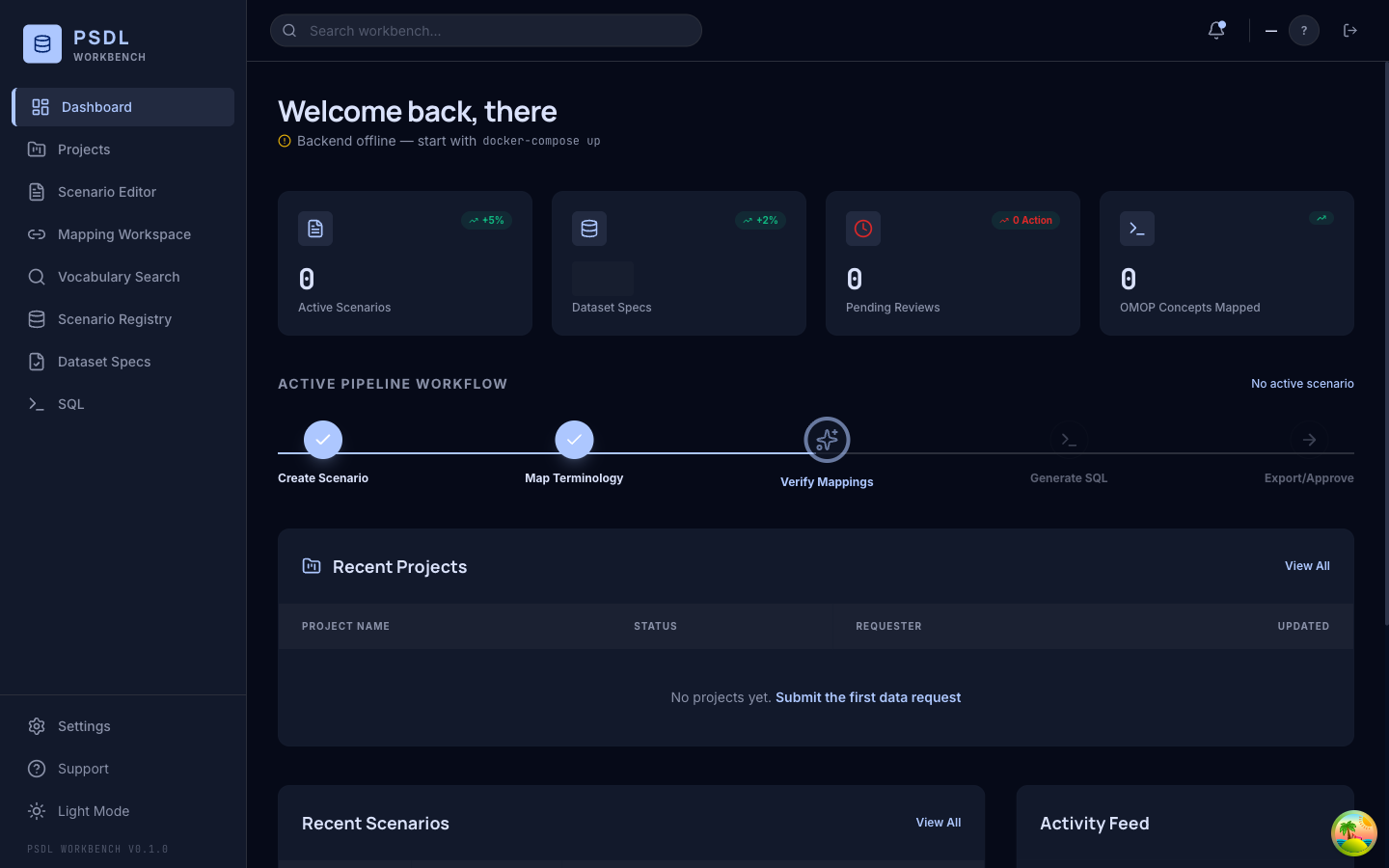
Forge as the cohort builder. HAVEN for consent and audit. PSDL to make every definition portable and reproducible across institutions.
Forge
HAVEN
Prometheno
PSDL family
Same scenario. Two simulated sites. Byte-identical hashes.
An AKI Detection scenario, authored once in psdl-inspector, compiled to a Certified Bundle, executed against MIMIC-IV (Site A) and a simulated dataset (Site B). The output hashes match. That is what reproducibility looks like at the protocol layer.
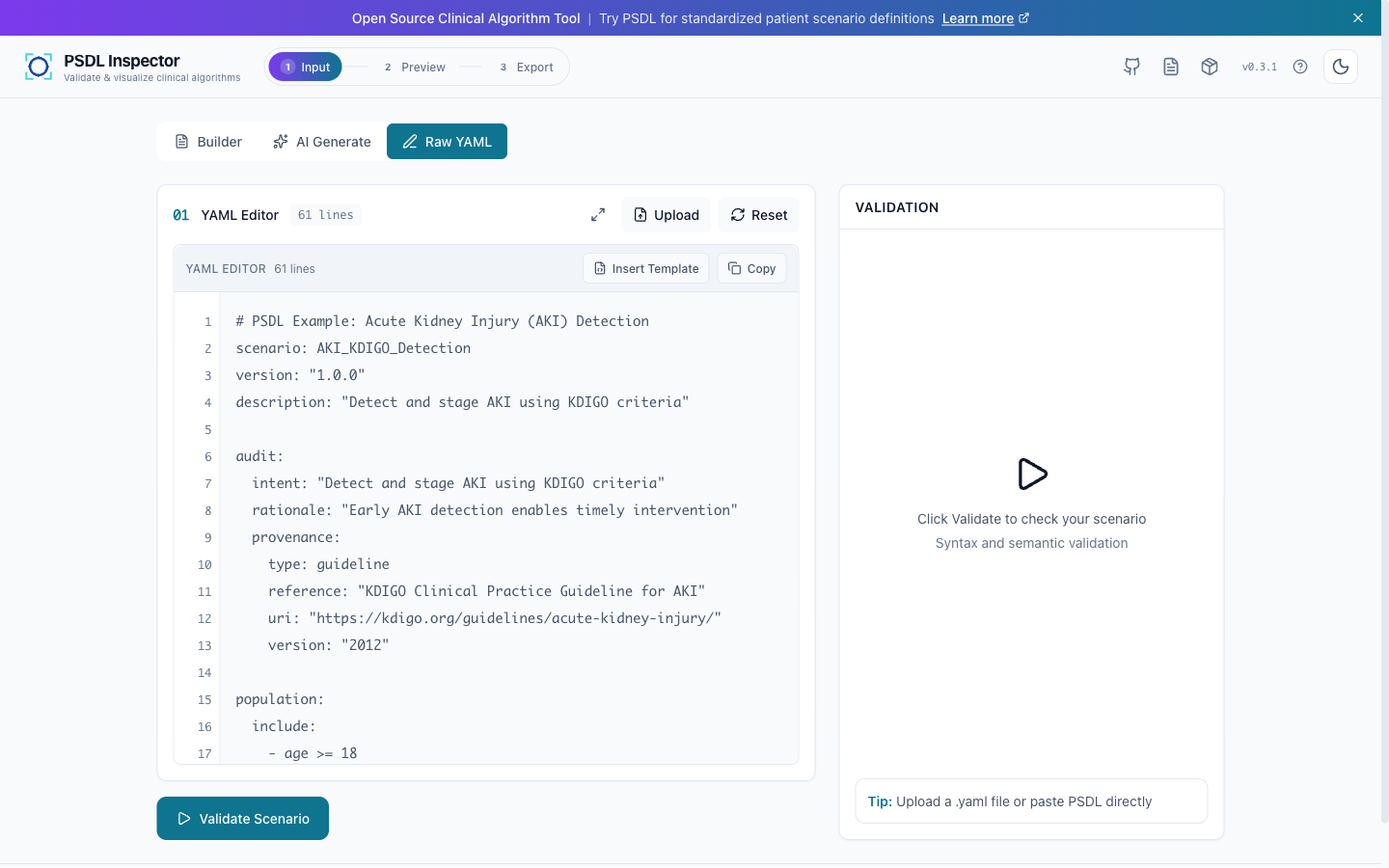
Author
AKI scenario in psdl-inspector with KDIGO criteria.
scenario: AKI_Detection audit: intent: ... rationale: KDIGO 2012 signals: { Cr: ... } trends: { delta_6h: ... } logic: { aki_risk: ... }Certify
Compile to a Certified Bundle. SHA-256 binds everything.
{ "bundle_version": "1.1", "checksum": "sha256:abc123...", "scenario": { ... }, "terminology_anchors": { "creatinine": { "concept_id": 3016723, "vocabulary_id": "LOINC" } } }Run · Site A
Execute on MIMIC-IV via Prometheno. Hash recorded in HAVEN audit chain.
$ psdl run bundle.json --site mimic-iv Triggered patients: 47 Result IR hash: 0x9799d065d19f...e583 HAVEN audit entry: #1247Run · Site B
Same bundle, different dataset. Hash identical. Reproducibility, proven.
$ psdl run bundle.json --site sim-b

Triggered patients: 31
Result IR hash:
  0x9799d065d19f...e583
HAVEN audit entry: #889

✓ Hashes matchThe MIMIC-IV Colab notebook runs end-to-end in your browser. No install.
Hashes shown are illustrative. Actual hashes match across runs of identical inputs.
Straight answers.
- How is Forge different from Atlas or i2b2?
- Cohort tools like OHDSI Atlas or i2b2 select patients by clinical criteria; consent is handled upstream, outside the tool. Forge is built so that cohort queries and exports run inside HAVEN consent scope, with the audit chain written as the query runs. In the reference implementation today this holds for study enrollment and payout; consent-scoped cohort export is the next milestone.
- What data model does Prometheno use?
- OMOP CDM 5.4 as the canonical model, with the full OHDSI vocabulary. FHIR R4 is used for ingestion and export. The platform is developed and tested on a 1,000-patient MIMIC-IV extract with 429,000 lab measurements.
- What is PSDL and do I need it?
- Patient Scenario Definition Language. You write a scenario or cohort definition once; it compiles to a signed, versioned bundle that runs identically on any OMOP or FHIR data source. Recommended for multi-site work, not required.
- What do I hand to my IRB?
- Your ethics review board gets the consent registry entries and the tamper-evident audit log, with proofs that each entry is in the log, generated from the same source that executed your query. Nothing is compiled by hand from spreadsheets.
- What does it cost?
- Prometheno is pre-pilot. The protocols underneath are open: HAVEN under CC BY 4.0, PSDL and VERITAS under Apache 2.0. For platform access and pilot terms, write to us.
- Can I run it on my own data?
- Yes. PSDL's data adapters are documented, and a Colab notebook runs end to end on MIMIC-IV. Prometheno's backend is the HAVEN reference implementation; its 27 protocol tests cover consent, audit, and value distribution.
When this works at scale.
Cross-institutional cohorts in hours, not months. Multi-site reproducibility as default. IRB documentation auto-generated from the same source as execution. Researchers spend their time on science instead of data acquisition.
The protocols underneath stay open: HAVEN under CC BY 4.0, PSDL and VERITAS under Apache 2.0. Prometheno is the platform that runs them.
The work is open. Pick your level.
MIMIC-IV Colab notebook. No install. End-to-end PSDL on real ICU data.
PSDL on your dataset. Adapter pattern documented. Tell us where the spec fails.
Adversarial spec review. Ambiguities, edge cases, contradictions.
Run a clinical research program? Test cross-institutional cohorts on your data.