PSDL.
Reasoning, sealed.
An open standard for clinical decision logic.
Clinical decision logic lives scattered — in proprietary EHR builds, in IRB PDFs, in model code nobody reviews. When an alert fires, or fails to, the chain is broken. PSDL is a written language for clinical reasoning. Every scenario carries its own intent, rationale, and provenance — validated by Inspector, sealed as an audit-ready record.
"Models don't fail because they're weak. They fail because reasoning can't be traced."
Take acute kidney injury. Three definitions shipped in two decades — RIFLE, AKIN, KDIGO — and all three still run, side by side, depending on which hospital, which year a build was last touched, which model was last retrained. The rule that fired last night on a real patient cannot be retrieved. Versions drift. Evidence chains are oral. Audit becomes archaeology.
IF GFR_decrease > 25%
  THEN FLAG_RISK()
sCr_rise >= 0.3 mg/dL
  WITHIN 48h -> alert
if model.predict(x) > 0.62:
alert()None can verify the others.
scenario: AKI_KDIGO_Detection
version: "1.0.0"

audit:
  intent:    "Detect and stage AKI using KDIGO criteria"
  rationale: "Early detection enables timely intervention"
  provenance:
    type:      guideline
    reference: "KDIGO Clinical Practice Guideline for AKI"
    version:   "2012"

population:
  include:
    - age >= 18
  exclude:
    - dialysis_status == "chronic"

logic:
  # KDIGO Stage 1: Cr rise >=0.3 mg/dL in 48h
  #   OR 1.5-1.9x baseline within 7 days
  aki_stage1:
    when: cr_delta_48h >= 0.3 OR (cr_ratio >= 1.5 AND cr_ratio < 2.0)
    severity: medium
Verifiable. Reproducible.
PSDL is what SQL became for data queries, ONNX for ML models, GraphQL for APIs —
a semantic layer for clinical decision logic.
A scenario written in PSDL is not a script. It is a record.
The certified bundle
What Inspector produces is not a report. It is an artifact of record — a sealed bundle that answers, for every clinical decision, the three questions a regulator will ask.
sha256:4f9c…d8a3
{
  "scenario":     "AKI_KDIGO_Detection",
  "spec_version": "0.5.0",
  "audit": {
    "intent":     "Detect and stage AKI using KDIGO criteria",
    "rationale":  "Early detection enables timely intervention",
    "provenance": {
      "type":      "guideline",
      "reference": "KDIGO Clinical Practice Guideline for AKI",
      "version":   "2012"
    }
  },
  "terminology_anchors": [
    { "signal": "Cr", "system": "LOINC", "code": "2160-0" }
  ],
  "hash":      "sha256:4f9c…d8a3",
  "signed_at": "2026-05-22T09:14:02Z",
  "certified": true
}
Human-readable for the IRB. Machine-readable for the pipeline. The same record, both ways.
PSDL Inspector
Open governance middleware. Inspector validates, visualizes, and certifies PSDL scenarios — turning a YAML file into an audit-ready bundle. Free, open, and usable today.
Author three ways
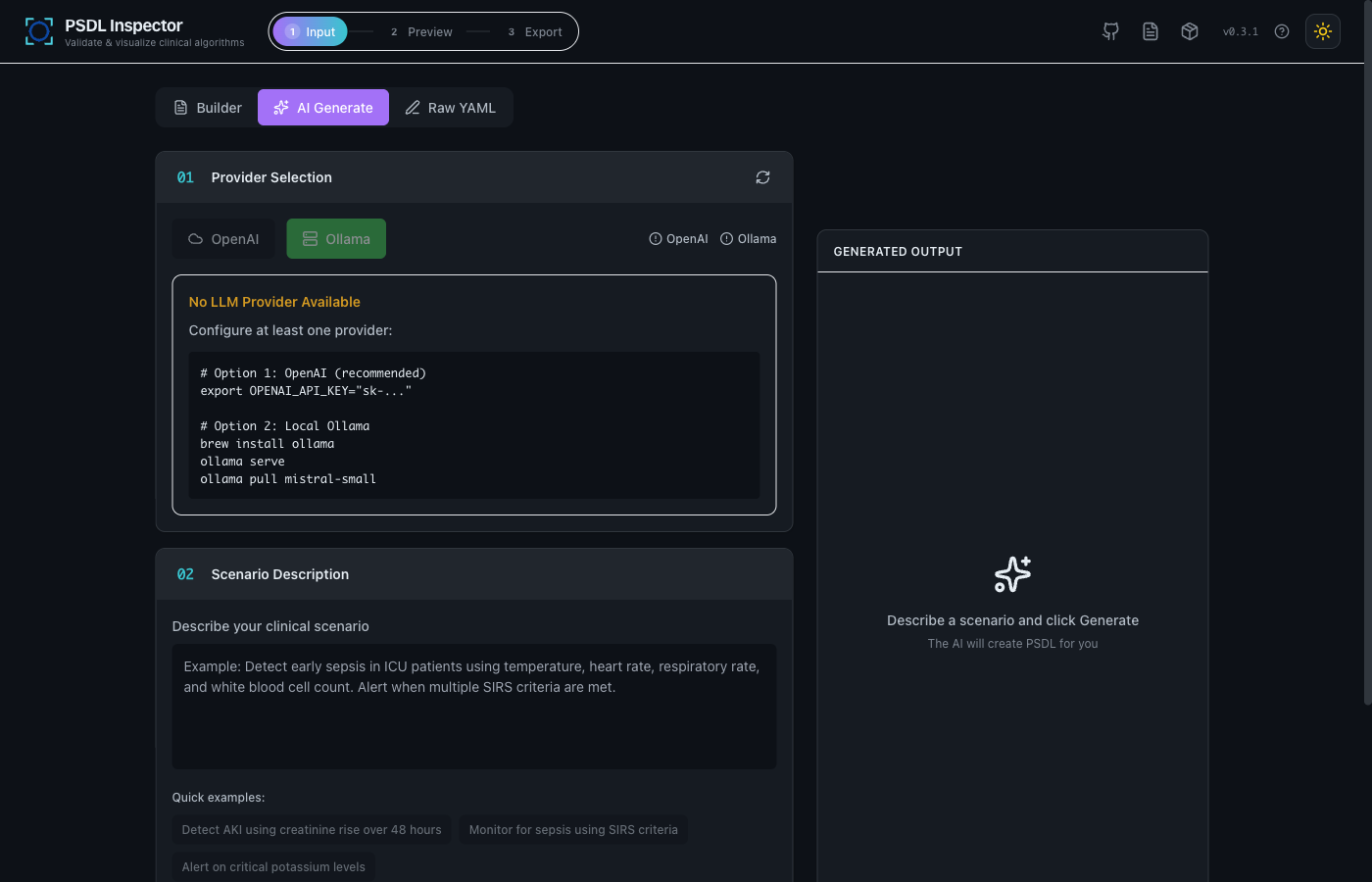
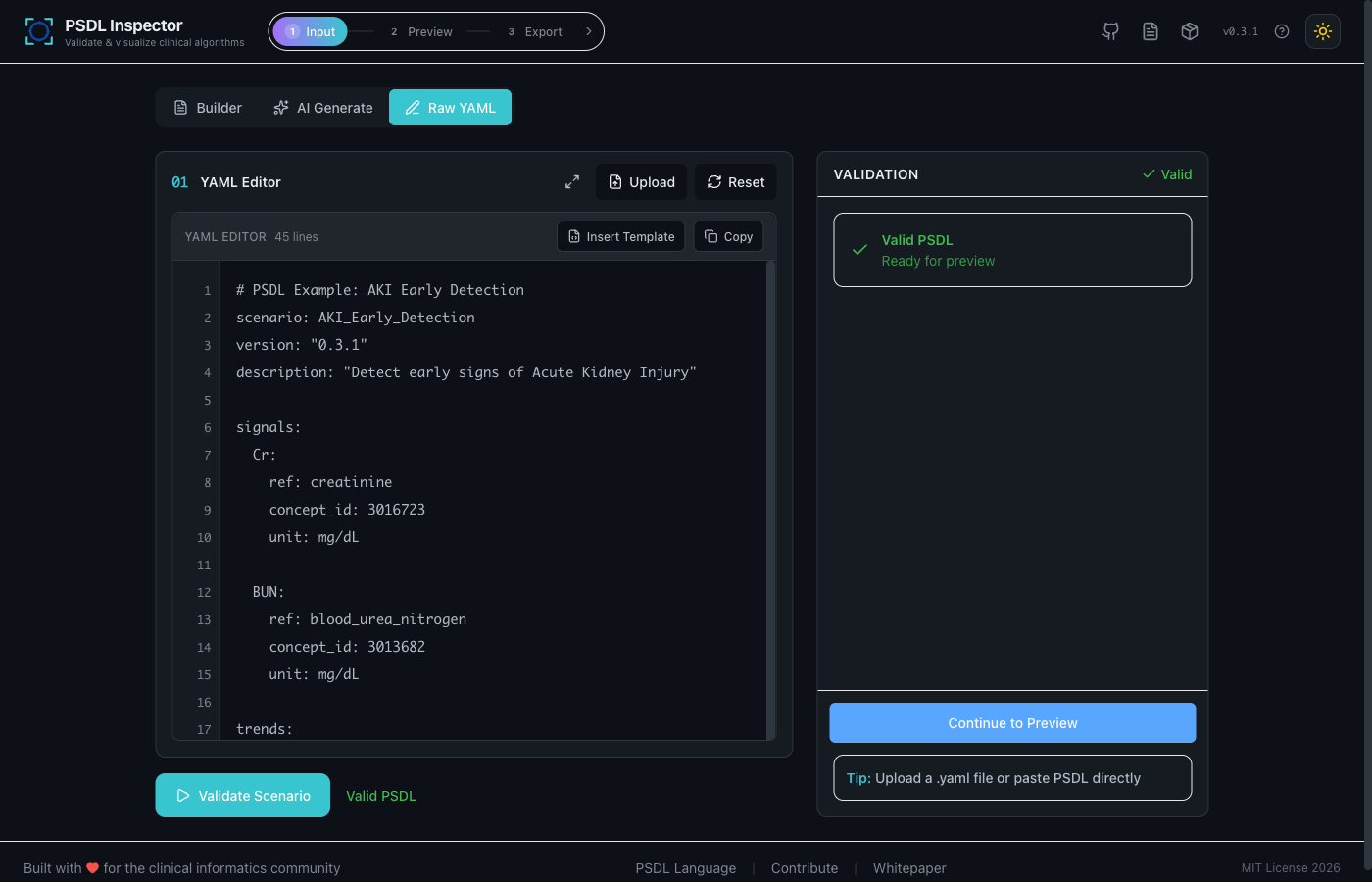
A guided Builder, AI generation from plain language (OpenAI or a local Ollama model), or raw YAML with live validation.
OMOP vocabulary search
Bind every signal to a real concept — SNOMED, RxNorm, LOINC — from a bundled OMOP vocabulary. Terminology is enriched and anchored, not free text.
Validate against the spec
psdl-lang checks structure, units, and references, surfacing errors inline before anything is certified.
Decision graph
Signals, trends, gates, and logic render as an interactive DAG with severity-colored nodes — the reasoning, made legible.
Certified bundle
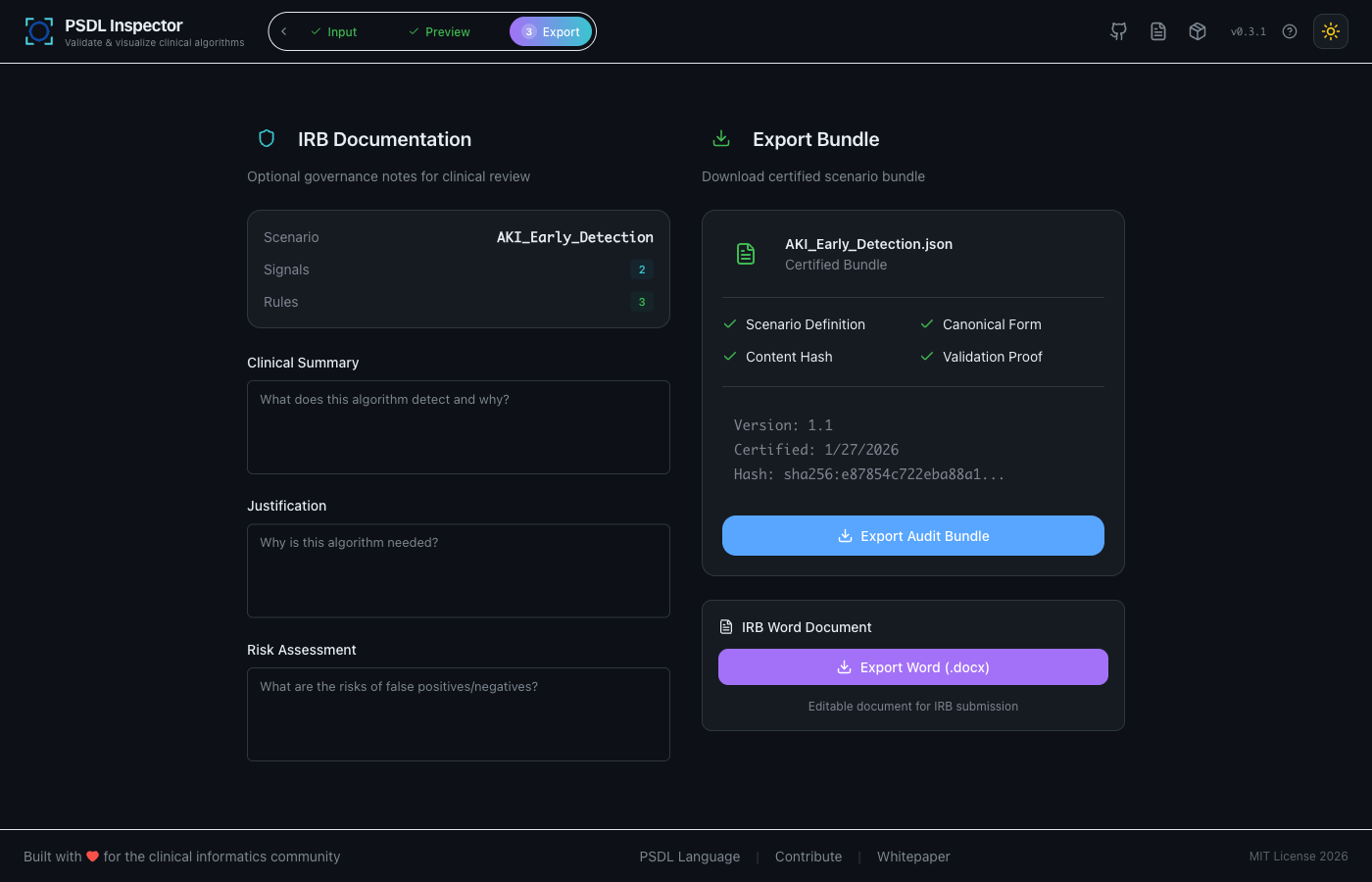
A checksummed audit bundle with terminology anchors and a governance checklist — tamper-evident and ready to hand over.
IRB Word + MEDS
Export AI-enriched IRB documentation as a Word file, plus a MEDS preview for downstream pipelines.
Inspector certifies the logic. It never connects to patient data, never executes scenarios, never touches PHI — that line is deliberate.
Author in the Builder or paste raw YAML. Inspector checks it against the spec, draws the decision graph, anchors it with a content hash, and exports a certified bundle — plus an IRB-ready Word document and a MEDS preview.
signals:
  Cr:
    ref: creatinine
    expected_unit: mg/dL
  Cr_baseline:
    ref: creatinine_baseline
    expected_unit: mg/dL

trends:
  cr_delta_48h:
    expr: delta(Cr, 48h)                # change over 48h
    unit: mg/dL
  cr_ratio:
    expr: last(Cr) / last(Cr_baseline)  # current / baseline
    unit: ratio
PSDL, the open standard
Inspector is one instrument. PSDL itself is the language underneath — an open specification (Apache 2.0) for writing clinical scenarios that carry their own intent, rationale, and provenance. It maps to OMOP and runs on real data: MIMIC-IV, PhysioNet, Synthea.
Clinical AI will be trusted only when its reasoning can be witnessed — not inferred from outputs, but read from the record, signed by whoever wrote it, against the evidence they stood on.
PSDL Workbench
Inspector defines and certifies the logic. Workbench runs it against your institution’s data. It takes a certified scenario, maps each concept onto your own warehouse schema, and generates the queries to extract the cohort — building a reusable mapping memory as it goes.
Built for health systems and research IT. Book a demo or scope a pilot with us.
Compare & talk pilot →