In the loop, not the dataset..
Your records sit in pieces across hospitals, labs, and apps you haven't opened in years. The studies you joined never tell you what they learned. We're building the patient app where data sovereignty is the default — you control who sees what, see what they did with it, and share in what your contribution earned. That's the patient seam of a larger trust system — the same work that rebuilds how researchers share evidence and how medical AI is held accountable.
Three pains, said plainly.
Your records are scattered
Different hospitals, labs, pharmacies, urgent care, that one specialist you saw five years ago. None of them talk to each other. You can't see your own picture. Neither can the next clinician who treats you.
You can't take them with you
Even when you can find them, getting your records released is bureaucratic theater — fax forms, phone calls, file uploads, and a wait. You own this data, but the friction of accessing it is everywhere.
The studies you joined never come back
You consented. You filled the surveys. You wore the device. The study finished, the paper got published, and you heard nothing. No findings, no recognition, no share of what your contribution made possible.
Ember — a patient mobile app where data sovereignty is the default, not a setting. Built on the HAVEN protocol. First pilot 2026.
Ember
Built on React Native + Expo. Connects to 28,000+ healthcare institutions via Fasten Health (SMART on FHIR / OAuth). Pulls your scattered records into one timeline you control. Shows every study request, every access, every finding that came back from research you joined.
The Impact Dashboard answers a question no one currently answers for you: what did your data do?
HAVEN consent + audit
The substrate underneath Ember. Every consent grant is scope-bound, machine-checkable, and revokable instantly. Every access to your data is recorded in a hash-chained audit log that even we can't alter after the fact.
Your scope. Your revocation. Your audit trail. The protocol is published (CC BY 4.0, DOI), so any future patient app can implement it — this isn't a Prometheno lock-in.
Contribution model
Tiered valuation: profile data, clinical data, and document data carry different weights. Quality assessment runs at ingest. When a study completes, the contribution registry attributes value back to the participants whose data moved the work.
Money is a bonus, not the point. The primary returns are findings (what the study learned), recognition (your name on the work, not buried), and priority (first in line for treatments your data helped develop).
Your records, your timeline, your impact.
Inside Ember — four views you’ll actually use.
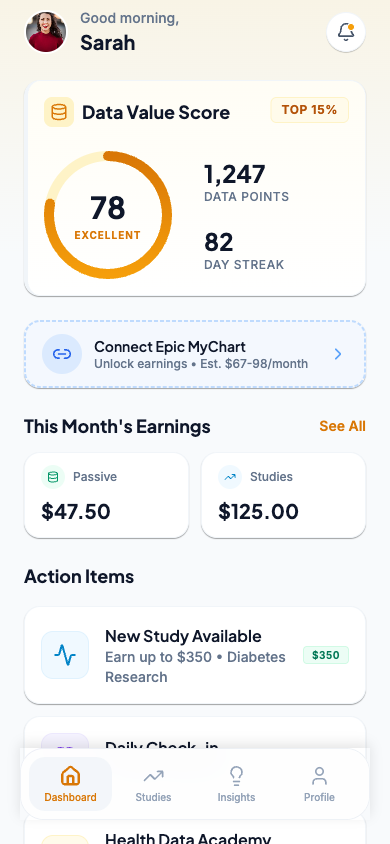
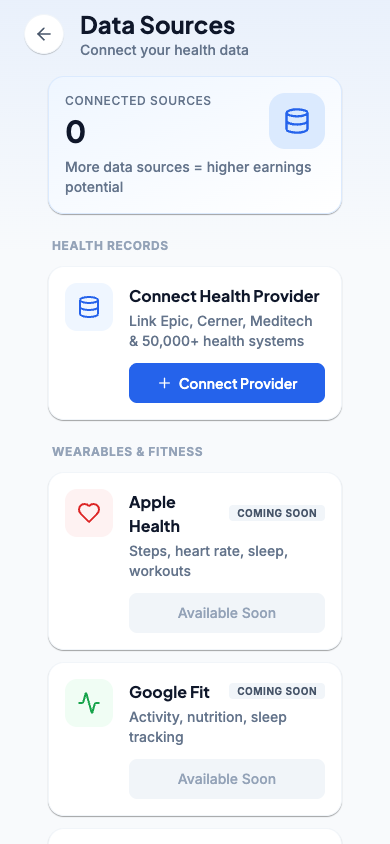
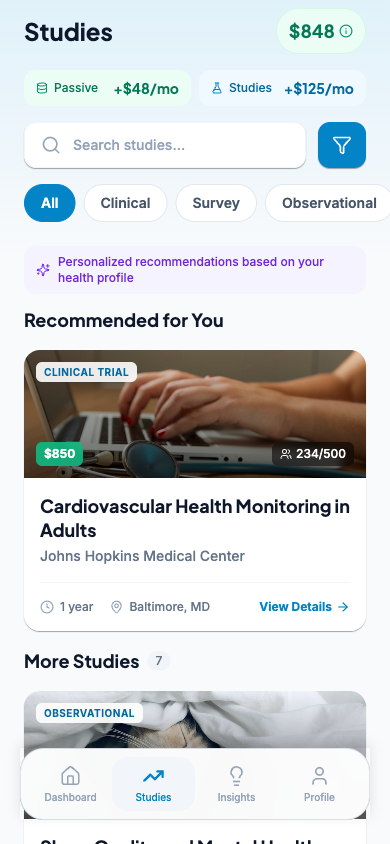
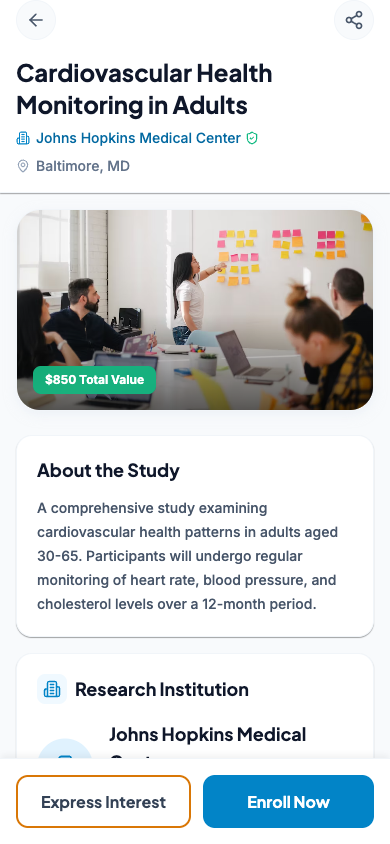
Live from the Ember app. Specific institution names, percentile claims, and dollar figures are mock illustrations — covered here to keep nothing readable as a real claim.
- Home — data value, sync status, day streak, recent activity.
- Connect — link Epic, Cerner, Apple Health, and 28,000+ other systems via Fasten.
- Studies — browse research you can join; manage what you've joined.
- Earnings — what your contributions paid out and what came of them.
Ember is built. The data shown above is illustrative — what you'll see when you connect is your own.
When this works at scale.
Studies that come home. Findings returned to the body they came from. Names credited where data was given. Money as bonus, never bait.
Ember stays free for the people whose data makes it. The protocols stay open — so sovereignty becomes the floor, not a setting. HAVEN governs the patient seam. PSDL makes researcher cohorts reproducible. VERITAS holds medical AI to what it actually does.
Straight answers.
- Is Ember free for patients?
- Yes. Ember stays free for the people whose data makes it. Patients never pay.
- Who can see my records?
- Only researchers you have said yes to, and only for the study and data you said yes to. Every time anyone opens your records, it is written to a tamper-proof log you can see in the app.
- Can I withdraw after I join a study?
- Yes, at any time. Withdrawal takes effect immediately and every later query is denied. What a finished study already learned from your data stays part of that study. Any share already paid to you stays paid; if you withdraw before a study finishes, you will not receive that study's share.
- What do I get back?
- An answer: what the studies you joined actually found. Priority: you hear first when a trial or follow-up study comes out of research you were part of. And a share of the value your data created, as a bonus.
- How do I connect my records?
- Through Ember, by logging into your hospital's patient portal (MyChart and similar). Your records are then mapped into a research-grade format. The first sync can take one to three hours depending on how much history you have. Available to pilot participants first.
- Is my data sold?
- No. Prometheno does not sell data. Researchers get access only to the cohorts and data patients consented to; your records stay governed by the HAVEN protocol, and you can revoke that consent whenever you want.
Three ways to be in the loop.
We'll email you when Ember opens to new users. One note. No marketing.
HAVEN is the open spec underneath. Understand exactly how your data is governed before deciding whether to participate.
If you run a patient community (chronic-disease group, research-engaged cohort) and want to be a launch partner, write us.