
Now let's think together. In The identity gap I said identity-proofing rides on existing institutions, not on crypto. This post is the same shape, different regime: clinical truth rides on existing medical practice. What HAVEN delivers is what the protocol layer can deliver — quality grading at ingest. The clinical-truth verification happens where it should: in medicine.
Two questions a record makes#
A clinical record claims two things at once.
First — this byte sequence is the one that was written. Crypto answers that. Hash matches, signature verifies, chain intact. Done.
Second — the byte sequence describes the patient's body. Glucose was 247. The diagnosis was correct. The procedure happened. Different question. Not because crypto fails at it; because crypto isn't pointed at it.
Three concrete ways the second question goes wrong:
Wrong patient. Two MRNs swapped at intake. The lab value belongs to someone else's blood. Signature, timestamp, chain — clean.
Wrong recording. The phlebotomist drew from a contaminated line. The instrument read 247. The instrument was reading the IV bag.
Wrong interpretation. "Type 2 diabetes" assigned to a patient whose elevated A1C was steroid-induced. The patient doesn't have diabetes. The record says they do.
The chain is fine. The record is well-formed. The data is just wrong about the body. Catching this is medicine's job, and medicine has been doing it for centuries.
What HAVEN solves#
HAVEN's contribution at this layer is the 3-Gate Quality Protocol from §6.4. Reproducible, machine-verifiable quality grading at ingest.
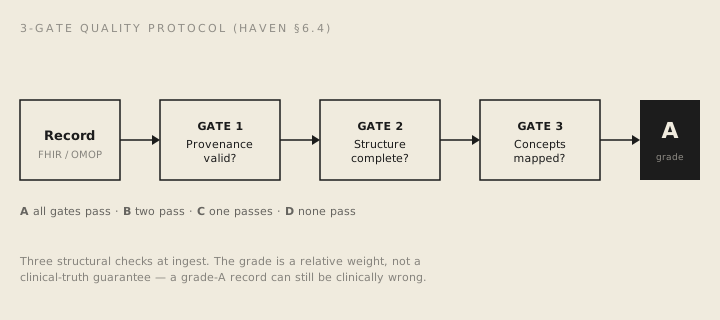
Gate 1: Provenance valid. Cryptographic chain intact, signatures verify, hash hasn't moved. Catches custodian-level tampering.
Gate 2: Structure complete. Required OMOP fields populated. FHIR resources validate against schema. Required relationships resolve. No nulls in required positions.
Gate 3: Concepts mapped. Diagnosis codes resolve to standard vocabularies (SNOMED, RxNorm, LOINC1) rather than local custom strings. Measurement units standardized. Medications map to active ingredients.
All three pass → A. Two → B. One → C. None → D. The grade rides on the record's metadata, visible to anyone who pulls it.
What the grade buys you#
Before quality grading, a researcher pulling a cohort had two options: trust the source, or audit every record by hand. A reproducible grade gives them a third — filter to grade A and know exactly what was checked.
An AI vendor training on a grade-A cohort gets a cleaner training signal than one training on raw mixed-grade data. Models can be validated against the grade.
A patient who contributed records sees their contributions weighted by grade. HAVEN's 3-Tier Value Model ties the grade to the attribution score2. Quality matters for compensation.
The grade isn't a clinical-truth guarantee. It is the strongest claim the protocol layer can make on its own — and it already changes how research-grade data gets compiled.
Where clinical truth lives#
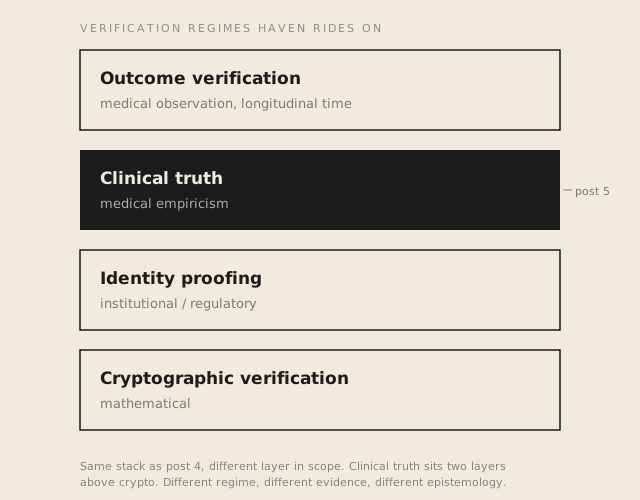
Clinical truth — whether the record matches the body — lives in medical empiricism. Repeated observation, independent measurement, longitudinal follow-up. The protocols are mature: Good Clinical Practice guidelines for trial data3, data monitoring committees, multi-source validation, adjudication panels.
These have been doing the work for decades, by people who do nothing else. The protocol layer connects to them. It doesn't try to be them.
The decomposition is the design#
A protocol that tried to verify clinical truth on its own would have to run adjudication panels. It would have to be a mortality registry. It would need credentialed physicians on staff. That's not a protocol — that's a research institute.
HAVEN decomposes the work. Quality grading runs at the protocol layer, where it scales across institutions. Clinical-truth verification runs in the medical regime, where it already happens. The two meet at the attribution layer — research outcomes flow back, tied to graded contributions, validated against medical-empirical evidence4.
The longer-term arc — paying patients when their data contributes to outcomes, paying or penalizing AI vendors when predictions match or miss reality — depends on this decomposition holding. Quality is the protocol's job. Truth is medicine's. Both are necessary. Neither substitutes for the other.
What comes next#
Posts 2 through 5 have argued what would happen if the protocol works. The next post commits to what would prove the whole argument wrong.
References
-
SNOMED CT (Systematized Nomenclature of Medicine, Clinical Terms), RxNorm (NIH unified medication nomenclature), and LOINC (Logical Observation Identifiers Names and Codes) — the OHDSI/OMOP standard vocabularies for diagnoses, medications, and laboratory results respectively. ↩
-
HAVEN whitepaper v2.0, §6.4: Quality Assessment and the 3-Tier Value Model. DOI: 10.5281/zenodo.18701303. ↩
-
International Council for Harmonisation. ICH Harmonised Guideline: Good Clinical Practice E6(R3). ICH, January 2025. Normative standard for the conduct of clinical trials, including source-document verification and endpoint adjudication procedures. ↩
-
U.S. FDA Center for Devices and Radiological Health, Software as a Medical Device (SaMD) — Clinical Evaluation, and the IMDRF SaMD framework. Validation of clinical AI/ML is empirical and ongoing, separate from data-integrity verification. ↩